

Each year, IJA provides a small group of college journalists with virtual training, hands-on reporting opportunities and mentorship through the Indigenous Journalism Fellowship. This year’s cohort represents Indigenous communities across the Pacific and North America.
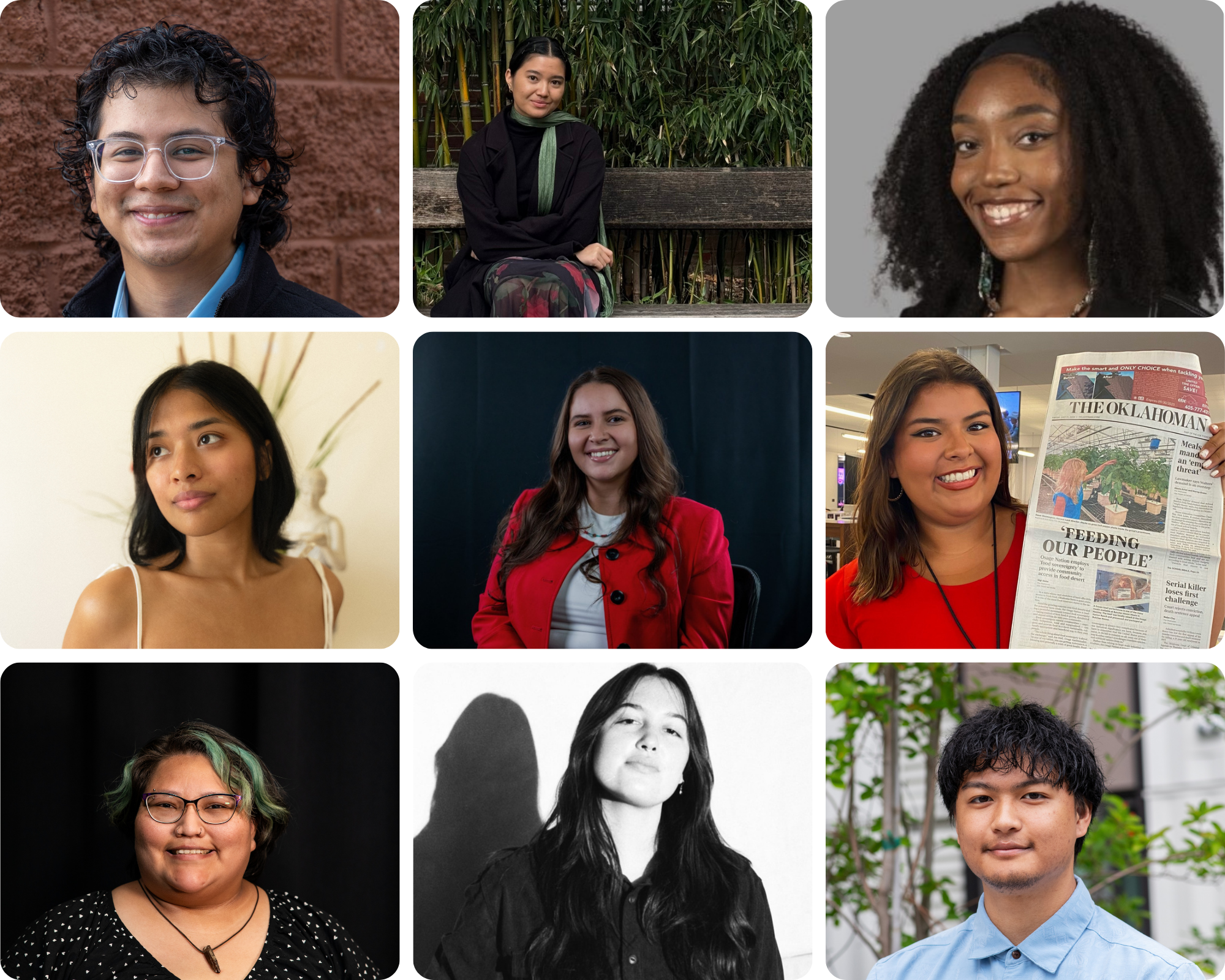
IJA’s 2026 fellows from top left: Joseph Morales, Connor Arakaki, Lauryn Callis, Kianna Reyes, Tara Roanhorse, Gianna Sieke, Trina Tsinnie, Bella Trigg and Kalani Chai-Andrade. Credit: IJA.
By Connor Arakaki (Kanaka Maoli), Bella Trigg (Yup’ik) and Lauryn Callis (Muscogee and Cherokee)
When Tara Roanhorse encouraged classmate Trina Tsinnie in 2023 to join the Indian Leader, the campus newspaper of Haskell Indian Nations University, neither expected journalism would become the foundation for their careers or friendship.
The two Diné students quickly became newsroom partners, writing about student life at Haskell, before expanding their work into broadcast journalism. At the beginning of this year, the Indigenous Journalists Association awarded both of them spots in the Indigenous Journalism Fellowship, the organization’s flagship program for college journalists.
Tsinnie now serves as secretary of the Indian Leader while Roanhorse has taken the helm as vice president. Their friendship, to Tsinnie, is an example of how Indigenous journalism inevitably creates lasting professional and personal connections.
“Because we were both from the same tribe, Tara encouraged me, and helped me to open up,” Tsinnie said. “I look up to her, and I’m motivated to get outside and report, to be uncomfortable and to write.”
Tsinnie hopes the Indigenous Journalism Fellowship will foster new connections as she, Roanhorse and seven other emerging Indigenous journalists work together in IJA’s student newsroom at the annual Indigenous Media Conference. This year’s conference is hosted at the Portland Marriott Downtown Waterfront in Oregon from July 22 to July 24. While Tsinnie and Roanhorse are from the same university and tribe, this year’s fellowship promises to broaden their network as IJA brings together students from Indigenous communities across the Pacific and North America.
This week, the nine fellows—traveling from Saipan to New York—are gathering after months of virtual training and one-on-one mentorship that they received from experienced Indigenous journalists. For much of the week, they will work on live-coverage of programming during the conference, a gathering of hundreds of people on the traditional lands of the Multnomah, Wasco, Kathlamet, Clackamas, Chinook, Tualatin, Kalapuya, Molalla, and present-day Grande Ronde, Siletz and Cowlitz peoples.
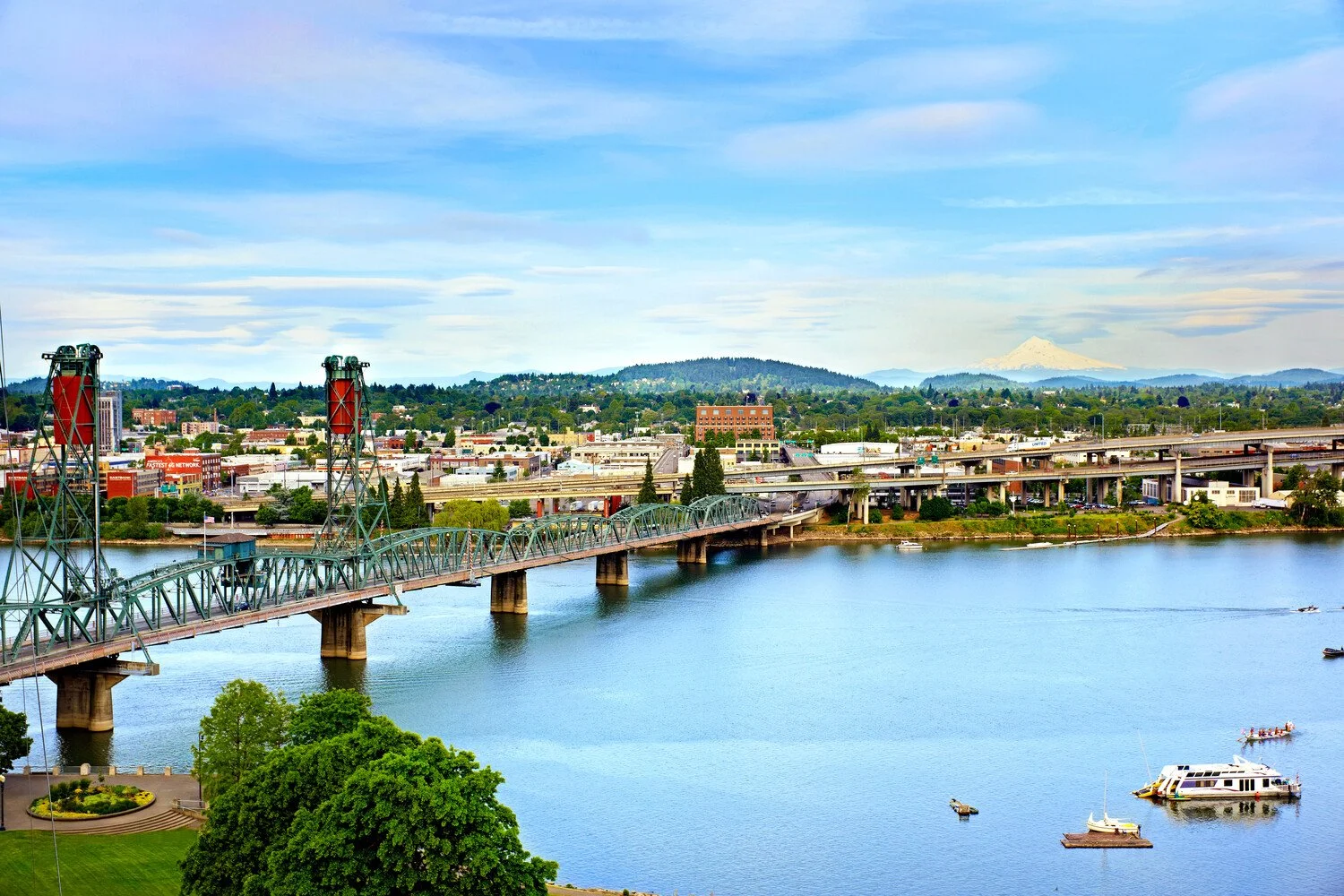
The 2026 IJF cohort will focus on live coverage of events and programming during the Indigenous Media Conference in Portland, Oregon. Courtesy image: Portland Marriott Waterfront Downtown.
Supporting Indigenous communities globally
As the most geographically diverse fellowship cohort to date, the 2026 fellows represent Native communities in six U.S. states and territories, and their interests range from TV broadcast and radio journalism to print, photography and digital media. Some will be working in the same newsroom with another Indigenous journalist for the first time and several fellows added that they are the sole reporters that they know of who are covering Indigenous issues on their campuses.
In addition to Tsinnie and Roanhorse, this year’s fellows include Kalani Chai-Andrade (Kanaka Maoli), Joseph Morales (Tohono O’odham), Kianna Reyes (CHamorru and Micronesian), Gigi Sieke (Osage, Sac and Fox, and Absentee Shawnee) and the three authors of this article—Connor Arakaki (Kanaka Maoli), Lauryn Callis (Muscogee and Cherokee) and Bella Trigg (Yup’ik).
The inclusion of three Pacific Islander journalists among the fellows represents a transition within IJA toward supporting Indigenous communities globally, a shift the organization underscored in 2023 when it changed its name from the Native American Journalists Association to IJA.
The visual storytelling work of Chai-Andrade, a Kanaka Maoli photojournalist from Kea‘au, Hawai‘i, and Reyes, a CHamorru and Micronesian filmmaker from the Northern Marianas Islands, reflects the conference’s broader celebration of Indigenous visual media and performing arts. For example, theconference will host a performance by hula halau Ke Kai O Kahiki, led by Kumu Hula La‘akea Perry, and a preview screening of Hula: Becoming Kumu, a documentary film by the Kīkaha Foundation.
Morales, another fellow, is a citizen of the Tohono O’odham Nation, a federally recognized tribe in the Sonoran Desert whose homelands span southern Arizona and northern Mexico. An English student at Arizona State University, he focuses his reporting and photography on tribal affairs and community issues, most recently working for the Gila River Indian News. He has always been interested in writing, he said, but also recognizes that embracing photography provides a way for producing a complete story.
He views journalism as a means for raising awareness of his community — or as he states, to be “a voice for my nation.” Before the fellowship, Morales, who grew up in Coolidge, Arizona, said he hadn’t met many other Indigenous people in journalism. He is looking forward to meeting more professionals working in the field during the conference and learning from them as a way to elevate his skills.
“My nation is right by the U.S. Mexico border; the border actually cuts our nation in half,” Morales said. “This (fellowship) is a great way to bring awareness to where I'm from, but also hopefully elevate other communities along the way.”
In Lawrence, Tsinnie—also known as DJ Trina Bina on the air—hosts the Haskell Hour for KJHK, a student-run radio station at the University of Kansas, curating music and live radio segments for local students. She also works as a producer for Good Morning Indian Country, a weekly news program advised by IJA Board of Directors member Melissa Greene-Blye that Haskell and University of Kansas students produce together.
Journalism was never really the end goal for Tsinnie, an avid reader whose passion for writing began at Haskell in fiction and studies business administration. Yet, her fellowship experience, particularly her mentorship from Carrie Johnson, who routinely edited Tsinnie’s stories throughout the summer and is advising her applications process for graduate school in journalism, solidified her change of heart.
“Before, my dream was to open up a bookstore and a publishing company for Indigenous people, so they’ll always have a place where they could publish and sell their books,” Tsinnie said. “I still want to do that, but for now I just felt that was too easy, and journali sm is something challenging that would get me moving. I felt like I needed to move.”
>> Read more about this year’s IJF cohort <<
Editor’s Note: This story was reported as part of the Indigenous Journalism Fellowship, a program of the Indigenous Journalists Association for emerging storytellers. News outlets are encouraged to republish the fellows’ work under our story-sharing guidelines without charge. Please retain the bylines and photo credits. Do not make major edits beyond adjusting dates and making style changes that suit the needs of your publication. IJA appreciates receiving a link or copy of the published story, which you can email to mary@indigenousjournalists.org.