

Shannon Shaw Duty, who has led the Osage News since 2007, won the Minnie Two Shoe Award for Excellence in Tribal Media and the IJA-Medill Milestone Achievement Award for her contributions to an independent and free press in the Osage nation.
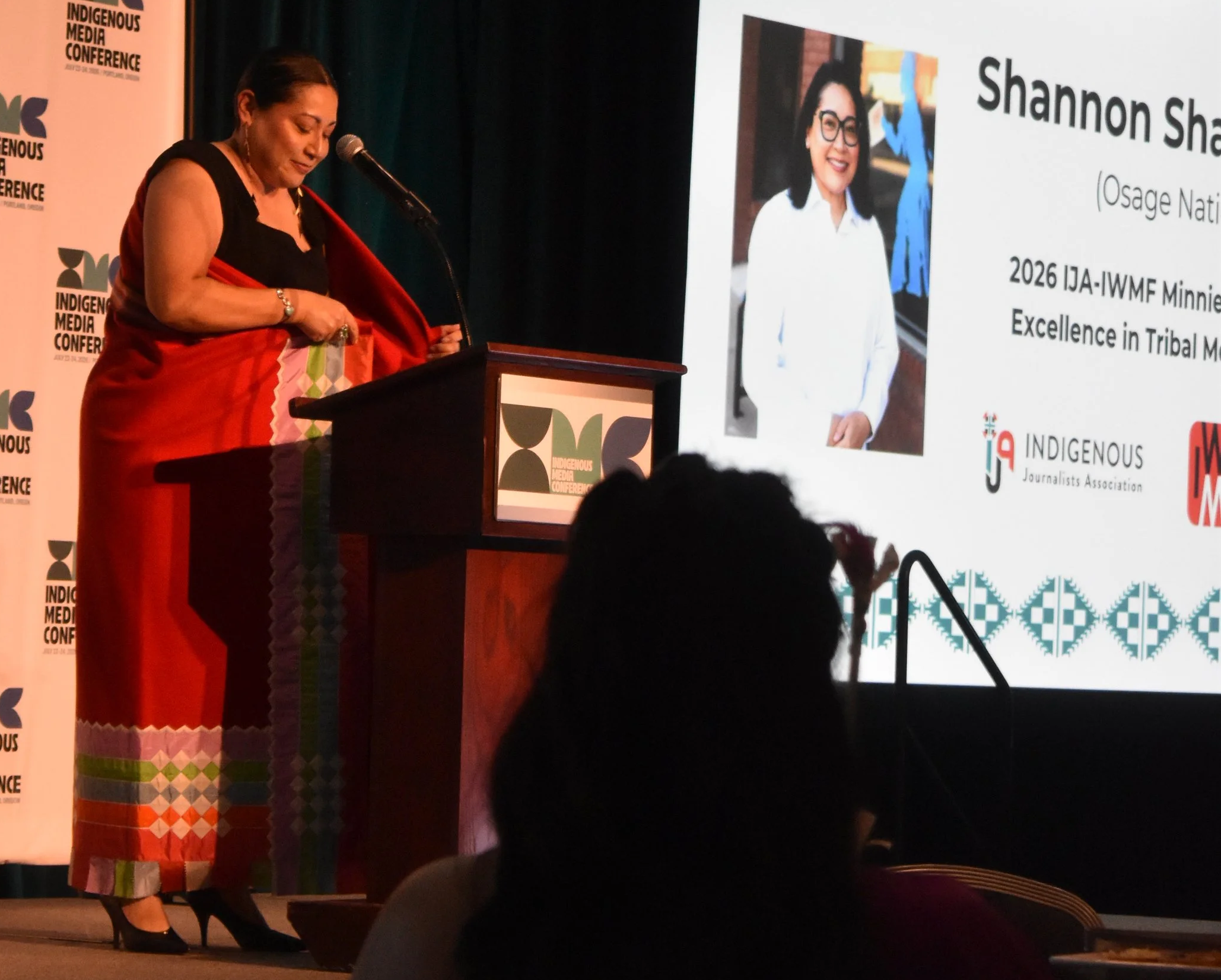
Shannon Shaw Duty delivers remarks during the Indigenous Media Awards Banquet on July 24 in Portland, Oregon. Photo by Bella Trigg.
Adorned with a blanket made by her mother, Osage journalist Shannon Shaw Duty opened her awards speech with the words of the inimitable Assiniboine journalist Minnie Two Shoes.
“Our responsibility as journalists is serious, but it doesn’t mean we can’t have fun sometimes,” Shaw Duty said. “Receiving an award is to honor her fearlessness that created space for the journalists after her. I hope to honor her legacy by asking the hard questions, continue to have a free press, mentor future journalists and continue the hard work of informing the Osage people.”
In addition to the Minnie Two Shoes Award, Shaw Duty received the IJA-Medill Milestone Achievement Award. Her tireless dedication to rigorous journalism, democracy and the free press of the Osage Nation has made her, in the words of IJA president Sunnie Clahschischiligi, a “legend.”
Under her leadership of the Osage News since 2007, Shaw Duty helped pass the 2008 Independent Press Act — later upheld by the Osage Nation Supreme Court — and shape its ongoing amendments.
“Community journalists are at their very best when they have lived within their community for an extended amount of time, knowing and loving generations of people who have come and gone,” Shaw Duty said. “Yet, it’s difficult, and you have to have a strong sense of self, a strong sense of knowing that you are doing the right thing and that you have chosen this profession with intention.”
Friday’s awards ceremony, which honored 128 Indigenous journalists, was the culmination of the annual Indigenous Media Conference, hosted this year in Portland, Oregon, on the traditional lands of the Multnomah, Wasco, Kathlamet, Clackamas, Chinook, Tualatin, Kalapuya, Molalla, and present-day Grande Ronde, Siletz and Cowlitz peoples.
Since 2007, Shaw Duty has led the Osage News as editor, and her reporting has investigated extractive taxation on tribal lands in Oklahoma and how historical trauma and conservative politics influenced COVID-vaccine hesitancy in the nation. Her work also helped inform the production of the 2023 Oscar-nominated film, Killers of the Flower Moon.
She follows in the footsteps of her mentor, Osage journalist Dennis McAuliffe Jr., who received the IJA-Medill award in 2015. When she was an undergraduate at the University of Oklahoma, she interviewed McAuliffe — who had released his 1999 book, Bloodland: A Family Story of Oil, Greed and Murder on the Osage Reservation — for a newsletter she wrote for Native American students. There, McAuliffe asked Shaw Duty the golden question: Did she want to be a journalist?
“From there, he’s helped guide my career all through to the Osage News — several internships, my full-time job, everything,” Shaw Duty said. “That’s really the person that gave me the bug.”
Visual storytelling was at the heart of programming for the final day of the conference, which featured panels, documentary screenings and the announcement of a new journalism network for Pasifika journalists. “Through Our Lens: Indigenous Photographers Documenting Indigenous Communities,” was one of four panels that opened the morning. Its four Indigenous photo and multimedia journalists offered insights on how to prioritize care, accountability and cultural knowledge in their visual practice.
Afterward, the conference screened two documentaries: People of the West, created by Brad Munoa (Pechanga Band of Indians/Payómkawichum) and Murder in Big Horn, directed by Razelle Benally (Oglala Lakota/Diné) and Matthew Galkin.
In the afternoon, journalists celebrated the official launch of the Pacific Islander Journalism Network, or PIJN, the first professional network dedicated to Pasifika journalists, media workers, students and academics across U.S. states and territories. According to Thomas Mangloña II (CHamorro), the editor-in-chief of Marianas Press and a co-founder of PIJN, the network hopes to fill a gap in resources and Pasifika-led mentorship for journalists across Oceania.
“For a long time, Pacific journalists in the U.S. have sought a professional network that recognizes the unique communities we come from and we serve,” Mangloña said. “This is our approach to making this happen.
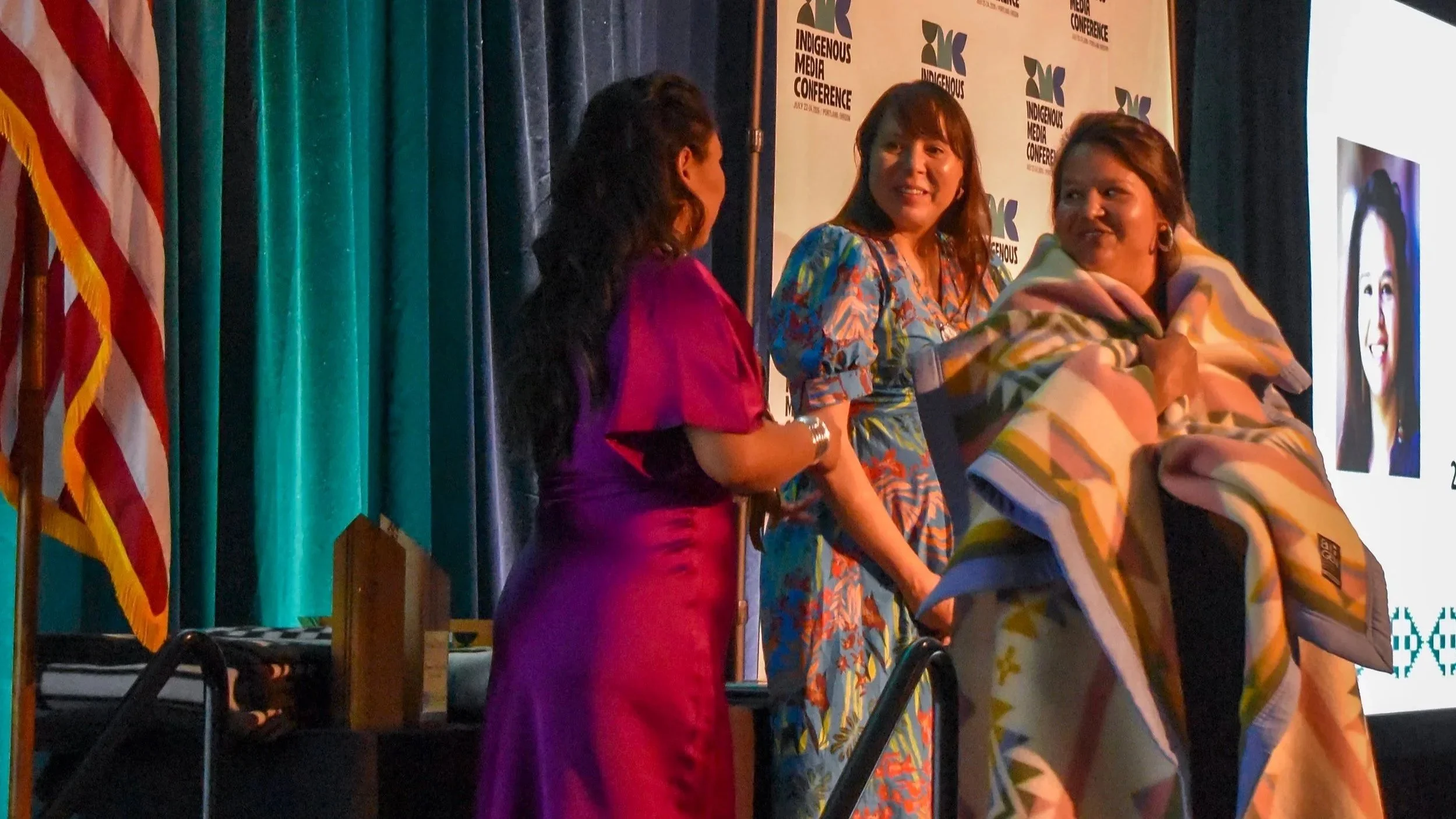
Chelsea Curtis, center, is honored with the Richard LaCoirse Award for Investigative Journalism. Photo by Bella Trigg.
Later Friday evening, IJA hosted the President’s Reception and Silent Auction, followed by the awards ceremony. Chelsea Curtis (Diné) received the 2026 Richard LaCourse Award for Investigative Journalism for her work at Arizona Luminaria, where she spearheaded the state’s first database tracking and verifying data on missing and murdered Indigenous women, girls, Two-Spirit and transgender people across tribal lands.
The two-year database project was published in March 2025, alongside a series of in-depth profiles that together painted portraits of Arizona families who have lost relatives to the MMIP crisis. “When an Indigenous woman goes missing, they disappear twice. Their body vanishes first and their memory second,” said Curtis during the awards ceremony.
Curtis said her dream for the project was to build an MMIP database that could humanize the people represented by the data. One of the moments that stayed with her was a conversation with a mother who had lost her daughter to homicide in 2024 and who shared how initial stories about the case were harmful because they focused only on the perpetrator.
“Her daughter got lost in the news cycle,” Curtis said. “When her profile was published, she shared how meaningful it was that I highlighted (her daughter’s) personality and dreams, rather than reducing her life to one terrible moment.”
Spanning 46 categories across three divisions — professional, associate and student — the IJA’s Indigenous Media Awards program is the most comprehensive in the country recognizing coverage of Indian Country. Darren Brown (Pueblo de Cochiti and Choctaw), senior content producer at Cheyenne and Arapaho Television, received the first place award in the professional television category for “The Carlisle Project.” The segment followed the return of 16 Cheyenne and Arapaho children who died at the Carlisle Indian School between the 1880’s and the turn of the century, so they could be reburied in their own tribal lands.
“The nature of TV can be invasive, any form of media could be, but I’ve worked with the tribe long enough that the community trusted me and the people I work with. There were a lot of talks and discussions with tribal leaders and elders before the story even began,” said Brown. “When you work with good people that you trust, it’s easier to do good work.”
Throughout the ceremony, presenters emphasized how the reportage of this year’s recipients was inventive and of enduring impact, breaking ground for the work of future Indigenous journalists. Tara Gatewood (Pueblo of Isleta/Diné) underscored how Shaw Duty’s leadership has been vital to preserving the freedom of press and democracy in the Osage nation.
“Shannon Shaw Duty represents the very best of tribal media leadership, combining journalistic excellence with cultural understanding and a fierce dedication to press freedom,” Gatewood said. “Her work has not only strengthened the Osage News but also created a model for what tribal media can achieve.”